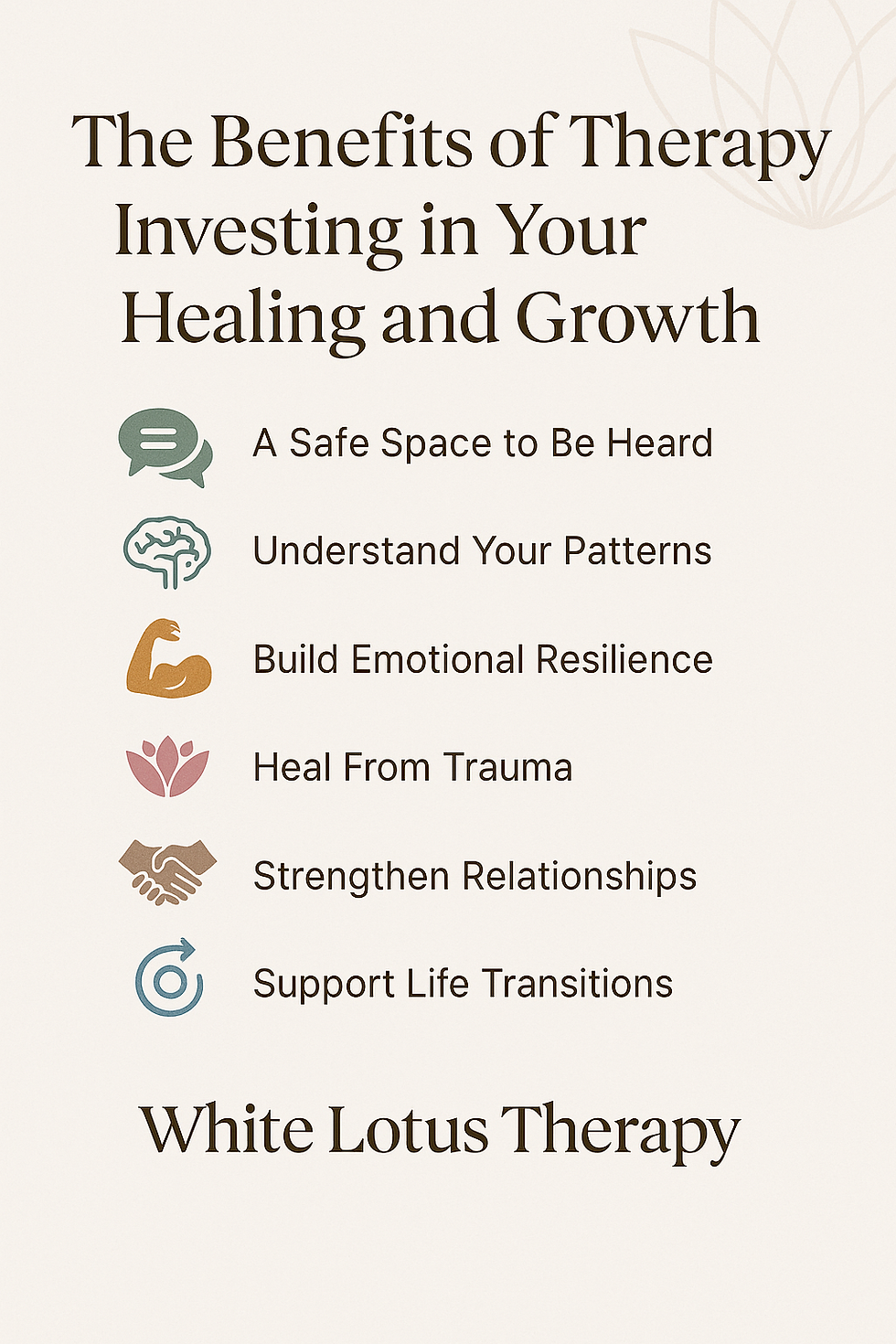
The Benefits of Therapy: Investing in Your Healing and Growth
Therapy is often thought of as a last resort, something we seek when we’re in crisis. But the truth is, therapy is a proactive, powerful form of self-care—a transformative process that helps us build insight, resilience, and stronger relationships.
At White Lotus Therapy, we view therapy as an investment in your well-being. It’s a chance to reconnect with yourself, make peace with your past, and begin living more fully in the present. Whether you are navigating trauma, stress, neurodivergence, or emotional burnout, here are the many ways therapy can help—and the science that supports it.
🧠 1. Therapy Helps Rewire the Brain
Neuroplasticity, or the brain’s ability to reorganize and form new neural connections, means that change is always possible. Research shows that therapy—especially trauma-informed approaches—can help regulate the nervous system, shift thought patterns, and improve emotional regulation.
For example, Brainspotting, a method we use at White Lotus Therapy, taps into the subcortical brain where trauma is stored and bypasses the neocortex. Studies show Brainspotting can significantly reduce symptoms of PTSD, anxiety, and emotional dysregulation (Hilton et al., 2017).
🧪 Research Insight:"Psychotherapy changes brain function and structure" – Journal of Psychiatry & Neuroscience (Frewen & Lanius, 2006)
🌿 2. A Safe and Regulated Space for Healing
Therapy provides a co-regulated space—where the therapist’s calm and attuned presence helps regulate your own nervous system. This creates the conditions necessary for healing trauma, which often arises in the absence of safety.
💬 “Trauma is not what happens to you, but what happens inside you as a result of what happened to you.” – Dr. Gabor Maté
In therapy, especially when grounded in polyvagal theory (Porges, 2011), clients learn how to move from survival states (fight, flight, freeze) into states of connection, calm, and clarity.
🧩 3. Understand Root Causes and Break Cycles
So many of us struggle with patterns—whether it’s self-sabotage, people-pleasing, avoidance, or emotional shutdowns. Therapy provides the mirror to examine these patterns with compassion and curiosity. You begin to understand the "why" behind your behavior, uncover core wounds, and develop healthier responses.
📚 "Until you make the unconscious conscious, it will direct your life and you will call it fate.” – Carl Jung
💬 4. Build Stronger Relationships
Therapy strengthens emotional intelligence and communication skills. It helps you understand your attachment style, set boundaries, and navigate conflict more consciously. Whether you're working through childhood wounds or current relationship struggles, therapy can be a catalyst for relational healing.
🧪 Research Insight: A meta-analysis in Psychological Bulletin (2011) found that psychotherapy significantly improves interpersonal functioning, particularly in emotionally focused and attachment-based therapies.
🌊 5. Process and Heal Trauma
Trauma isn’t just held in memory—it’s held in the body. Somatic-based therapies like Brainspotting, Sensorimotor Psychotherapy, and EMDR access the deep layers where trauma resides. This body-mind connection is essential for true healing.
🧠 “The body keeps the score.” – Dr. Bessel van der KolkHis research (2014) confirms that trauma impacts areas of the brain responsible for fear, memory, and regulation—and that bottom-up approaches are often more effective than talk therapy alone.
At White Lotus Therapy, we integrate Brainspotting, mindfulness, and body awareness to support lasting trauma recovery.
🌻 6. Improve Mood and Reduce Symptoms
Therapy is an evidence-based treatment for anxiety, depression, PTSD, and more. Techniques like CBT, DBT, and
help reframe distorted thinking, build coping strategies, and reduce emotional suffering.
🧪 Research Insight: According to the American Psychological Association, 75% of people who engage in therapy experience benefit and symptom relief.
🔄 7. Support Through Life Transitions
Therapy can be a steadying force during difficult life transitions—grief, divorce, identity shifts, parenting challenges, or burnout. It helps you navigate these seasons with intention, supporting you to rebuild, reflect, and realign with your values.
🌈 8. Empowerment Through Self-Compassion
Ultimately, therapy teaches you how to treat yourself differently—to shift from self-criticism to self-compassion. This inner change affects every area of life: your health, relationships, confidence, and ability to set goals and pursue dreams.
💬 “Self-compassion is simply giving yourself the same kindness you'd give to a friend.” – Kristin Neff, PhD
Why Choose White Lotus Therapy?
At White Lotus Therapy, we offer a holistic, trauma-informed, and neurodivergent-affirming approach. We draw on evidence-based practices like Brainspotting, CBT, DBT, and somatic therapies to help clients feel safe, empowered, and deeply supported.
🧾 Covered by NIHB and most private insurance
🖥️ Virtual and in-person available
💬 Free 15-min consults
We believe healing is your birthright. You don’t need to be “broken” to begin therapy. You just need to be willing to show up for yourself.
Ready to take the next step?
🌐 www.whitelotustherapy.ca📧 sasha@whitelotustherapy.ca | 📞 204-471-4245📍 Winnipeg, MB | Serving all of Manitoba (virtually)
Rooted in compassion. Rising in strength.
📚 References:
Frewen, P.A., & Lanius, R.A. (2006). Toward a psychobiology of posttraumatic self-dysregulation: Reexperiencing, hyperarousal, dissociation, and emotional numbing. Journal of Psychiatry & Neuroscience, 31(1), 14–25.
Hilton, L., et al. (2017). Effectiveness of Brainspotting: A case study and literature review. Journal of Psychotherapy Integration.
Porges, S. W. (2011). The Polyvagal Theory: Neurophysiological foundations of emotions, attachment, communication, and self-regulation.
Van der Kolk, B. (2014). The Body Keeps the Score: Brain, Mind, and Body in the Healing of Trauma.
Cuijpers, P., et al. (2011). The effects of psychotherapy for adult depression are overestimated: A meta-analysis of study quality and effect size. Psychological Bulletin, 137(3), 429–443.
Neff, K.D. (2011). Self-Compassion: The Proven Power of Being Kind to Yourself.


Comments